Creative Economy Job Trends 2020–2025: What ArtCube’s Data Shows
18 minutes read 401 0

TL;DR

INTRO

Creative work has evolved.

For the past several years, the trade headlines have practically been writing the film industry’s eulogy: shrinking production volume, shutdowns, labor strikes, the rise of AI as a creative tool, and real financial stress across the entire Film + TV ecosystem. That story is true and palpable. It’s just not the whole story.

The filmmaking whiplash, booming one minute, stalled the next, has been brutal to live through and to watch. But our data shows a second, quieter truth beneath the noise: when skills can move across industries, the workforce doesn’t disappear, it reconfigures. Diversity creates resilience. Cross-industry skills create continuity.

That signal is hard to see inside Facebook groups, where job posts vanish down a bottomless feed and trolls thrive where there's no accountability. On ArtCube, your data isn't used to sell ads; it’s used to help you. We keep the culture professional and the signal clean—because in this community, reputation matters.

"Cube's revenue growth and job volumes move in a near-perfect parallel... if you aren't working, we aren't growing."

The data is yours

Data Transparency = Career Clarity

Most job boards and social groups are extractive; they gather your data, monetize it, and hide the results. We do the opposite. At ArtCube, we believe the data belongs to the people who create it.

Our pulse is tied directly to yours. When the industry stalls, we feel it too—not just as observers, but financially. Our revenue growth and job volumes move in a near-perfect parallel. Simply put: if you aren't working, we aren't growing. We have a massive stake in your success because we take a hit right along with you.

That’s why we’re committed to showing you the baseline. Even when things feel bottomless (like the lows of 2023), the data shows we are currently on an absolute upswing. We are moving toward a full recovery, and we’re sharing these insights so you can plan your next move with confidence.

Yes, as a platform, we have "user data", but it is my stern conviction that this data belongs to Cubers.

What most industry reporting can’t show is the part that matters most: how freelance film crew survived, if they did.

ArtCube isn’t just a job board or castoff marketplace anymore. It’s become a cross-industry creative connections hub, a place where work can reroute when one lane shuts down.

When Film + TV started to exit stage left, the spotlight didn’t go out. It moved. Marketing and Social Media trends, events, and interactive builds surged to create unforgettable experiences that sell, built with the same storytelling craft as movies.

ArtCube does.
Read on.

"I love ArtCube... it offered me the opportunity to save myself and change industries during the pandemic."
Adaptability is measurable.

About this data

Disclaimer: Job-post data shows correlation and timing, not direct causation, so we treat this article as a likely interpretation based on data and empirical and numerical evidence, rather than a definitive claim that this happened everywhere.

This is what happened on ArtCube Nation,

ArtCube’s Creative Jobs Data is built from member-generated job posts and opportunities across multiple creative sectors.

This dataset does not measure studio output, box office revenue, network budgets, or vendor profit. It measures something different: where work showed up, how the workforce adapted in real time, and what adjacent trends helped fill the gaps.

That distinction matters. A drop in film production volume doesn’t automatically mean that crew was inactive. What we saw instead is that work often redistributes into nearby industries that value the same skills: logistics, building, design, installation, and coordination.

Data note: Because posts are member-entered, some listings from 2020–2025 are miscategorized, especially under “Other.” In our next taxonomy sweep, ArtCube will introduce a Skilled Labor category and re-tag applicable posts.

Help us keep the signal clean: choose the right post type when you post. Accurate selections strengthen the dataset and the insights we can return to Cubers.

Jobs by Project Type (2020-2025)

Percentages across all job posts.

Chart note: This five-year pie chart is a true summary of 2020–2025, but it’s not a snapshot of today. Film + TV represents a large share of the five-year mix because it dominated earlier years.

New taxonomy soon!

Skilled Labor in the Creative Economy

As ArtCube analyzed job posts from 2020–2025, one thing was clear: we overlooked a huge part of the workforce, Skilled Labor.  Operations roles, like CNC operators, movers, and professional organizers, are the behind-the-scenes work that keep fabrication shops, marketing agencies, and display installation projects moving forward. These jobs are critical to the creative economy, and they’re the reason we’ve added it as a dedicated professional category..

  • Art Handler
  • Cleaning Crew
  • CDL Truck Driver
  • Facility Manager
  • Forklift Operator
  • Furniture Assembler
  • Handyperson
  • Mover
  • Packing Specialist
  • Professional Organizer
  • Tile Installer
  • Upholsterer
  • Warehouse Assistant
  • White Glove Delivery Driver
  • Wood Finisher

Some of the new job titles under Skilled Labor

The five-year reset

When everything came to a screeching halt in early COVID, film work went dark. Events and theater went darker for longer because audiences weren’t gathering indoors, even as some film and content could still move outside. But creative infrastructure didn’t vanish. It pivoted.

Fabricators and shops took on nontraditional work. Many supported local businesses building outdoor setups and dining structures. Some were commissioned for civic needs, including PPE fabrication and other public-facing builds. People who usually stayed in one lane started crossing over.

Theater and event crew got crafty and joined the Cube for a nibble of opportunity, and that shift proved fortuitous. It became an early expansion point for ArtCube’s creative jobs scope, widening the network beyond a single industry lane.

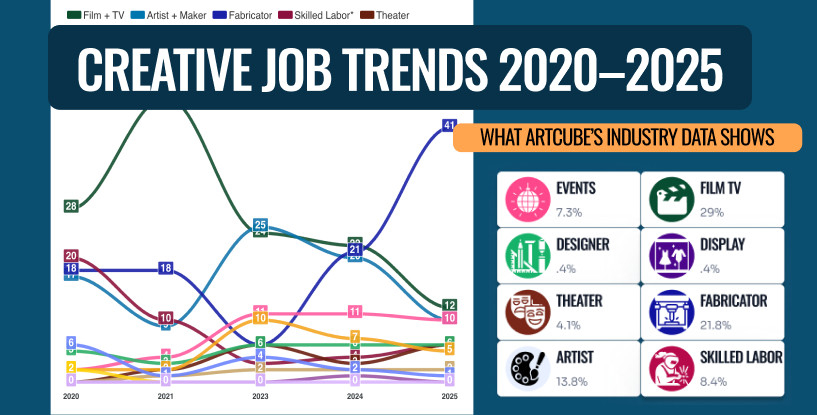
2020–2021: CREATIVE PROJECTS WAX AND WANE

job category percentage

In the category legend, hover to isolate or click to hide.

Even in lockdown, jobs didn’t stop — they were different but the skill set was the same.

Some of our members were commissioned by the city to fabricate PPE, turning their fabrication shops into micro-manufacturing hubs for masks and shields.

ArtCube data still shows that brief but vital surge: artisans building PPE,
It proved that creative infrastructure could pivot instantly and serve a civic purpose.

Then came the strikes of 2023 and the long IATSE negotiations that froze film work again.


This time, the transition was seamless. Many who had already shifted into fabrication or events stayed busy, while unions began welcoming displaced theater workers.

By 2025, it was clear — adaptability wasn’t anecdotal; it was measurable.
ArtCube’s data revealed a resilient workforce reorganizing itself across industries, following opportunity rather than waiting for recovery.

2022: Hybrid Work: Film Jobs Declined; Fabrication and Events Rose.

By 2022, a new pattern was forming: creatives built multiple income streams across categories. A set dresser could take an event install. A scenic painter could finish a pop-up. A fabricator could move between film builds and commercial activations.

Many of the event and theater members joined during the pandemic, looking for work because film was up first, since we could shoot outside. These new members began the expansion of what ArtCube delivered and certainly increased the diversity of industries we enjoy now.

2022-2023

In the category legend, hover to isolate or click to hide.

2023: Strikes Accelerate Diversification of the Creative Jobs Market

The WGA/SAG strike period hit film vendors and crew in a very real way. But what ArtCube saw inside the community was not “nothing .” It slowed, but there was a reshuffling of demand: more work concentrated in fabrication/installs and adjacent categories.

In 2023, the story wasn’t “no work,” it was work rerouting under pressure. With the WGA and SAG-AFTRA strikes disrupting traditional Film + TV pipelines, ArtCube’s posting mix shows demand shifting toward artists and makers in adaptable lanes. During the strike months (May–Sept), Fab/Install consistently took the largest share of posts, with Events also holding strong, while Film and TV made up a smaller slice of activity. In other words, when production slowed, the ecosystem leaned on the skills of travel, installation, fabrication, logistics, and on-site execution, keeping people in motion even when the industry’s main engine stalled.

Another factor is project scale. Even when films were still getting made, many were smaller and more cost-constrained. In that kind of environment, productions often source work from individual makers and freelancers instead of full fabrication shops, because shops carry higher overhead and typically price accordingly. The result can look like a “fabrication dip” at the shop level, while maker-level work stays active or even grows.


Where was work in 2023?

Artist + Maker: 8% → 25% of jobs (biggest jump)

  • Signal: More work getting routed into hands-on making: props, scenic craft, builds, fabrication-adjacent artistry.

2) Display + Merchandising: 2% → 10% (huge lift)

  • Signal: Brands, retail, and “physical marketing” starts showing up louder.

3) Tech: 1% → 4% (small number, strong direction)

  • Signal: More “tech-enabled” builds and production support.

  • What it indicates: Hybrid work: digital layers showing up inside physical projects (AV, installs, content capture, interactive elements).

4) Designer: 4% → 6% (steady growth)

  • Signal: More projects needing design leadership.

5) Theater: 5% → 6% (slight lift)

  • Signal: Live performance work was back.

6) Fashion: 1% → 2% (tiny, but doubled)

  • Signal: The talent pool is expanding.

   
Community Metrics Art Department Vendors and the Hollywood Strike: Film Industry Vendors who are hiring bar graph of what kind of job listings were hiring during the Hollywood Strike The Art Department Jobs in New York City were Fabrication, Commercials and "Other" projects like Photography and Fashion Week fabrication.  The films hiring film crew were "Microbudgets" SAG exempted from the strike. Art Department TV jobs totally flatlined.
(Repost) Taken from a 2023 article on the strike impact.

2024: Experiential Marketing, Social Media and Custom Fabrication

In 2024, the data shows the jobs were reshuffling demand: more work clustered in fabrication, installs, and adjacent categories as brands doubled down on experiences designed to stop the scroll. This shift is reflected in the broader experiential marketing conversation, too.

For example, BluEdge’s 2024 editorial, “Why Do I Need Custom Fabrication for Events and Activations?”, lays out how custom fabrication has become central to brand activations and live experiences, from immersive environments to interactive installations. (bluedge.com)

Consumer research also suggests experiential purchases strengthen social connections, one reason brands keep investing in experiences people want to share, and Madison Avenue called on Fabrication Shops. Journal of Behavioral Decision Making

But that was cold comfort for Filmmakers who were waiting for the "new normal".

Examples of Experiential Marketing Fabrication

example of interactive marketing fabrication Ghirardelli setup and Museum of Ice Cream display.
L to R: StoneDog Studios, for Ghirardelli, Sets and Effects for the Museum of Ice Cream

JOB CATEGORY PERCENTAGES

In the category legend, hover to isolate or click to hide.

2025: Custom Fabrication and Artisans

2025 is the clearest "do-si-do year". Film + TV is no longer the dominant lane, for the time being. Given the scant five years we studied, we see that industry markets can change on a dime.

Professional Category share in 2025 (percent of posts):


  • Fabricator: 41.1%

  • Events: 10.4%

  • Artist + Maker: 9.9%

  • Film + TV Crew: 11.6%

  • Designer: 6.3%

  • Skilled Labor: 5.6%

  • Theater: 5.6%

  • Display + Merchandising: 5.3%

  • (Everything else: small single digits)

ArtCube is increasingly a flexible project engine. When one industry steps back, the ecosystem steps forward.

Many film workers crossed over into adjacent arenas or created their own opportunities, as featured in our article Pivoting with a Purpose. The Art Department figures it out.

The Final Bow

The ArtCube Difference

Diversity equals health. It’s true for a forest, a stock portfolio, and it’s true for your career. It’s how we survived the last five years, and it’s how we’ll win the next five.

If you have peers still digging through "black hole" Facebook groups where the noise is loud and the accountability is zero—invite them over. Tell them to stop the "scroll and hope" method and join a professional ecosystem that actually has their back.

Sign up for ArtCube Nation. The no-troll zone where you can get back to the work.


FAQs

What counts as a creative economy job in ArtCube data?

In ArtCube data, a “creative economy job” means any member-posted paid work opportunity that supports making, building, styling, operating, or delivering creative projects across Film + TV and adjacent industries.

It includes posts in these lanes:

  • Film + TV crew (art department, set dec, props, scenic, coordinators, PAs, etc.)

  • Fabrication + installs (builders, carpenters, scenic, finish, shop roles, installers)

  • Events / experiential / brand activations (on-site build/strike, pop-ups, displays)

  • Artists + makers (artists, prop builders, painters, sculptors, specialty crafts)

  • Operations + support that keeps creative work moving (drivers, warehouse, logistics, facilities, load-in/out, organizers)

What it does not mean: it’s not a measure of studio output, budgets, or profits. It’s a measure of where paid opportunities showed up on the platform and how work shifted across categories over time.

What are the top twenty job titles posted on ArtCube?

The number are percentages of jobs posted between 2020 and 2025.

  • Carpenter7.7%

  • Art PA5.2%

  • Truck Driver3.7%

  • Installation Crew3.4%

  • Production Assistant3.4%

  • Art Assistant2.7%

  • Scenic Artist2.6%

  • Prop Master2.5%

  • Scenic Carpenter2.3%

  • Set Dresser2.2%

  • Custom Fabricator2.1%

  • Truck PA1.8%

  • Painter1.8%

  • Set Decorator1.8%

  • Art Director1.5%

  • Scenic Painter1.4%

  • 3D Model Maker1.3%

  • Renderer1.3%

  • Strike Crew1.3%

  • Photographer1.2%

What is ‘Skilled Labor’ in the creative economy?

In the creative economy, Skilled Labor is the hands-on, technical, and operational work that makes creative projects physically happen, on time and on budget.

It’s the infrastructure layer that Film, Fabrication, Events, and Installs can not do without.

Skilled Labor typically includes roles like:

  • Logistics + transport: truck drivers, cargo van drivers, loaders, movers

  • Warehouse + inventory: warehouse assistants, inventory managers, packers

  • Facilities + site support: handyperson, facility manager, forklift operator

  • Build support + finishing trades: furniture assembler, wood finisher, upholsterer, tile installer

  • On-site execution: white glove delivery, load-in/load-out support, install support


Does this data reflect the real world of creative work?

Mostly yes, but with clear limits.

What it reflects well

  • Demand signals: it shows where work opportunities were posted and how that mix shifted across Film + TV, Fabrication, Events/Experiential, Artist + Maker, and ops/support roles.

What it does NOT claim to measure

  • Total production volume, budgets, profits, or employment rates.

  • The full market in a city (it’s not a census).

The main biases are acknowledged 

  • Platform bias: it reflects ArtCube usage, so growth in a category can be partly “more people posting that work here,” not only “more work exists everywhere.”

  • Posting behavior: Some jobs get filled via word-of-mouth and never get posted.

  • Miscategorization: member-entered posts can be mislabeled (especially under “Other”), which is why taxonomy cleanup matters.


How do I use this data outside of NYC?

Here’s how to use it anywhere:

  1. Follow the direction, not the zip code
    NYC is our biggest market, so it’s loud in the mix. But the shift is portable: Film-only lanes got less reliable, and build-heavy work (fabrication, installs, experiential) became a stability layer.

  2. Use it to decide what to learn next
    Treat the top categories as your upskilling shortlist:

  • fabrication/shop skills

  • install/load-in logistics

  • scenic/finish skills

  • event builds + pop-ups
    Even in smaller markets, those skills attach to more kinds of work.

  1. Translate your role into adjacent lanes
    If you’re Film + TV, ask: “What’s my nearest neighbor category?”

  • set dressing → experiential installs / retail displays

  • scenic → fabrication finishes / pop-ups

  • prop makers → brand activations / product displays
    Same craft, different client.

  1. Use ArtCube to widen your radius safely
    You don’t have to move. Use the platform to:

  • find regional gigs and short runs

  • connect with vendors who travel

  • get on rosters for touring installs and pop-ups

  1. Compare your local reality to the trend
    If your city is still film-heavy, great. The data helps you see what to build as a backup lane before you need it.

Home base for crew, makers, and the people who hire them. Solid signal, real people, and a platform that has your back.

Connect. Crew up. Work. Repeat.

Join ArtCube

Share this with a trusted peer that needs to Cube.

Leave a Reply

MOST POPULAR

Recipe: Faux Marijuana

Form buds using maple syrup, smush them together, and put into microwave for 20 seconds or so, then roll in shake for re...

Nov 29, 2022 03:11
1 minutes read 4921 2 0

Slime Recipie

Any suggestions as to where I can find or make a non-toxic, slime or goop? I need about 500 gallons for an installati...

Feb 20, 2023 04:13
1 minutes read 3902 1 0